Feeds:
Posts
Comments

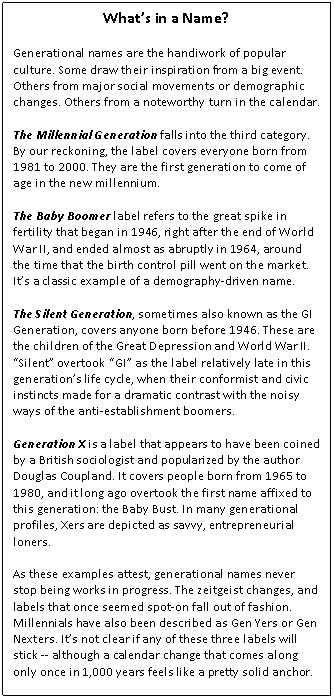
America’s newest generation, the Millennials, is in this coming-of-age phase. Who are they? How are they different? How are they being shaped by their moment in history? And how might they reshape America in the future? The Pew Research Center sets out to answer these questions in a yearlong series of original reports that explore the behaviors, values and opinions of today’s teens and twenty-somethings.

Read more and take a quiz to see how you compare to the Millennial Generation http://pewresearch.org/millennials/

Great Science for Girls (GSG) is seeking new partners. GSG developed a Request for Applications (RFA) and is encouraging intermediaries, direct service providers operating multiple afterschool programs, school districts, and other organizations to apply.  For more information and to view the RFA solicitation, please visit the GSG website: www.edequity.org/gsg/

Sponsor: American Humane Association

Deadline: 4/15/2010

Amount: varies

Type: Social & Economic, Education

Description: Through the Be Kind to Animals Kid Contest, the American Humane Association recognizes kids and teens who show extraordinary kindness to animals and go out of their way to help them.

The contest is open to children (between the ages of 6 and 12) and teens (13 to 17) who participate in activities such as volunteering at animal shelters or for other animal welfare organizations; helping raise money for causes that help companion animals: helping save and/or care for abused and neglected companion animals: demonstrating and strengthening the human-animal bond; raising awareness in their communities about animal-related issues; and lobbying for laws that protect companion animals.

Two grand-prize winners (one child and one teen) will each win $1,000 and two runners-up will each win $500.

Nominators who are nominating a child or teen who is not their son or daughter must have the parent read and sign a waiver.

Entry forms are available at the American Humane Web site.

Link to RFP

Sponsor: Harold W. McGraw, Jr. Prize

Deadline: 3/19/2010

Amount: varies

Type: Education

Description: Now in its 23rd year, the annual Harold W. McGraw, Jr. Prize in Education recognizes notable individuals in education who have mastered the art of “scaling up,” or building upon successful programs.

The McGraw Prize honors leaders from all three levels of education: elementary, secondary, and postsecondary. Winners must have developed programs exhibiting strong school-business partnerships, family engagement, use of cutting-edge technology, and data-driven decision making, among other practices.

Nominations are invited from the public. Only individuals who are presently committed to the cause of education and have been leading successful educational programs that have shown notable progress are eligible for nomination. Institutions, boards, organizations, or other groups are not eligible.

Recipients are honored at a dinner in New York City and each receives a $25,000 prize.

Nomination guidelines and forms are available at the McGraw-Hill Companies’ Web site.

Link to RFP
Girl Scouts seeks enthusiastic, creative and energetic counselors to facilitate summer day camp. You must be available to work from May 24th – July 30th . Camp closed June 28th – July 9th. Good role model with mature judgment. Applicant must be 18 years or older. CPR and first aid certification required. Life guard certification preferred. Spanish a plus. Please email or fax (520-319-3199) your resume or bring/mail to SGSC, 4300 E Broadway Blvd., Tucson, AZ 85711. The full job description and applications are available on our website www.sahuarogsc.org.

Thursday, February 18, 2010 from 9:30 am to 2 pm

(participate as you are able)

Arizona Legislature, 1700 W Washington in Phoenix

It was one year ago – on February 18, 2009 – that the State began turning away eligible families and placing them on a child care subsidy “waiting” (denial) list. To date, 11,187 children have been denied, with 17,000 children projected to be denied by June 30th.

Sponsored by the Arizona Child Care Association, Association for Supportive Child Care, Protecting Arizona’s Family Coalition, the Early Care and Education Consortium and Children’s Action Alliance.

View and/or share the flyer, which includes the day’s schedule of activities.  AZ Child Care Day 2010

Article in the Arizona Daily

Wrightstown school likely to shut, send kids to Henry

Posted using ShareThis

DEADLINE: April 1, 2010
Ranging in size from $1,000 to $10,000, Phoenix Suns Charities Program Grants are intended for Arizona non-profit organization whose programs and activities focus on helping children and families maximize their potential.
http://www.nba.com/suns/charities/grants.html

Find Youth Info

FindYouthInfo.gov is the U.S. government Web site that helps you create, maintain, and strengthen effective youth programs. Included are youth facts, funding information, and tools to help you assess community assets, generate maps of local and federal resources, search for evidence-based youth programs, and keep up-to-date on the latest, youth-related news. http://www.findyouthinfo.org/topic_afterSchoolPrograms.shtml

There is a page for afterschool programs, and includes a mapping tool to find resources to support and strengthen youth programs:

Map My Community is a tool designed specifically to assist you in locating resources in your community to help you build and strengthen your youth program. Get ideas for new partnerships, identify gaps in your community, and learn about resources to avoid duplication of effort.

The After-School Corporation recently released a series of short videos that make the case for doing science after school. The videos are each 1-2 minutes in length, and show kids and their group leaders engaging in lively hands-on science activities in after-school programs.

Why Do Science After School?
Engaging in science after school is not a substitute for having kids acquire basic math/science skills and knowledge at school. It’s a way to excite kids about acquiring that knowledge, to involve them in tactile, surprising, real-world applications. See the telescope build by Harlem third graders in this video:
http://www.vimeo.com/8896015

 Science Training for After-School Educators
Programs don’t need science or math experts to lead activities. Well-trained after-school educators are in some ways better prepared to model the inquiry process, given that they discover the answers to science inquiries alongside kids. See the difference training can make:
http://www.vimeo.com/8896687 

Oobleck
Oobleck is a hands-on science activity that introduces kids to inquiry, observation and states of matter. Here’s one after-school educator trying Oobleck for the first time with her kids:
http://www.vimeo.com/8896274

Who Does Science?
At the beginning of the After-School Science PLUS curriculum, after-school educators ask kids to draw pictures of scientists. After several months of science programming, the kids do the “Who Does Science?” activity again. This time, the results are very different:
http://www.vimeo.com/8896981